 Sandbox
 LAND Buyers Should Compare Parcel Fit, Location, Authenticity, and Total Cost Before Paying
Last updated -Sandbox LAND buyers should compare parcel format, coordinates, token contract, seller terms, and total transaction cost before approving a purchase. A 1x1 parcel may suit a compact Experience, while an Estate supports a larger footprint. Location can affect discovery, but it cannot promise traffic or resale value. Confirm the network and contract, read exactly what the listing transfers, and keep enough of the listing’s payment currency plus the applicable network fee.
Compare the parcel’s publishing fit, coordinates, contract, bundle terms, and total payment and network cost before approving any LAND transfer.
How Do Purchase Routes Change the Checks Before Payment?
The purchase route changes where parcel details appear and whether a marketplace mediates the transaction. Apply the same checks to public sales, map-linked listings, and private owner sales.
| Purchase Route | Payment and Network | Parcel Checks | When to Stop and What Happens After Transfer |
|---|---|---|---|
| Public LAND sale when active | Polygon SAND, plus the displayed gas option | Account eligibility, chosen Standard or Premium type, sale terms, and wallet details; the parcel is randomly assigned | A booking may expire before approval; a confirmed transfer has no automatic platform reversal |
| Map-linked secondary listing | The network, listing currency and amount, and fees shown for that listing | Coordinates, owner, token ID, collection contract, and bundle terms | Leave the request unsigned if fields disagree; unwinding a completed purchase requires another transfer |
| Direct owner sale | Terms negotiated with the owner on the LAND’s current network | On-chain owner, contract, token ID, coordinates, recipient, and consideration | No marketplace dispute channel applies to a direct transfer; recovery depends on a cooperating counterparty |
In the normal case, the coordinates, owner, contract, and chain agree, so the buyer can continue to wallet review. When one field conflicts, the reversible action is to leave the approval unsigned and reconcile the discrepancy. After purchase, compare the on-chain owner field with the connected account inventory rather than submitting a second payment during a display delay.
Public Sale Route
Public sales take place only when an eligible sale is open. The documented sale flow assigns a random parcel from the selected Standard or Premium type, so buyers do not choose its coordinates. The account must meet that sale’s verification requirements, while the connected wallet needs Polygon SAND and a supported way to cover gas. Availability, parcel type, and the purchase window belong to the specific sale.
Secondary Listings and Direct Owner Sales
Secondary listings allow selection of known coordinates and seller-defined terms. A direct owner sale removes the marketplace listing interface, so every token field and transfer condition must be compared directly. In either route, the wallet request should match the parcel already reviewed.
Parcel Size and Publishing Fit
Parcel format should follow the Experience footprint and publishing plan. Buying unused space adds cost without resolving design, performance, or publication requirements.
Single LAND Footprint
A 1x1 LAND provides a 96x96 block base and a height of 128 blocks. Each block represents one cubic metre within the platform’s scale. That footprint supports a 1x1 Experience, so the planned project should fit its horizontal dimensions and use vertical space sensibly before the parcel is chosen.
Estate Scale and Orientation
An Estate combines adjacent 1x1 LAND parcels into a larger unit. Defined Estate sizes include 3x3, 6x6, 12x12, and 24x24 arrangements. Current publishing tools require an Estate for an Experience larger than 1x1, and its placement must preserve the orientation used during creation. Estates can also be divided into smaller Estates or individual parcels.
Standard and Premium Terms
Standard and Premium 1x1 LAND have the same build dimensions. Premium status describes placement near or beside a partner Estate and may include additional NFTs in an initial sale. A secondary Premium listing transfers those extras only when the seller explicitly includes them. The designation does not establish future traffic, activity, or resale demand.
Price, SAND, and Network Cost
Total cost combines the listing amount, any marketplace charge shown in the order, network gas, and any cost of acquiring or moving the required payment token to the correct network. Purchases on The Sandbox website use Polygon SAND. Depending on the available transaction flow, gas may be covered with POL, SAND, or an available gasless transaction. A secondary listing can use a different payment currency and have different marketplace or network conditions.
Compare SAND-priced candidates in SAND. When listings use different currencies, convert each amount to the same cash reference at the same time. The comparison should also identify whether the listing contains one LAND, an Estate, or separately itemized NFTs. No expected resale value belongs in the purchase-cost calculation.
How Much Weight Should Map Location Carry?
Map location matters when it supports the intended publishing and discovery plan. Proximity to active partner Estates or social hubs may improve visibility, but nearby ownership alone does not establish future visits. Compare fixed coordinates, parcel shape, visible neighborhood activity, and the Experience footprint. Neighboring content and participation can change after purchase, while the LAND coordinates remain tied to the token.
Contract, Chain, and Seller Verification
Listing verification should connect the displayed parcel to one token, one current owner, and one supported contract before the wallet opens.
Collection Contract
LAND uses the ERC-721 token standard on Ethereum and Polygon. The supported Polygon LAND contract is 0x9d305a42A3975Ee4c1C57555BeD5919889DCE63F, while the supported Ethereum contract is 0x5CC5B05a8A13E3fBDB0BB9FcCd98D38e50F90c38. A familiar collection name or image cannot replace this contract check.
Coordinates and Ownership
Coordinates should identify the same map parcel across the listing and token record. Match the token ID, current owner address, network, and contract before evaluating price. A copied coordinate label can describe a real location while the listed token belongs to another collection or owner.
Bundle Terms and Approvals
The listing should state whether it transfers only LAND or also includes separate NFTs. Those assets have their own token records and do not follow the parcel automatically. Read the wallet request for its action, recipient, network, and amount. A purchase may involve a SAND spending approval before the marketplace submits the transfer.
A mismatch should stop the unsigned request, not trigger a guessed correction inside the wallet. Reopen the parcel record and reconcile each field. Once every field agrees, the final wallet preview becomes the last comparison point before commitment.
Wallet Approval and Post-Purchase Reconciliation
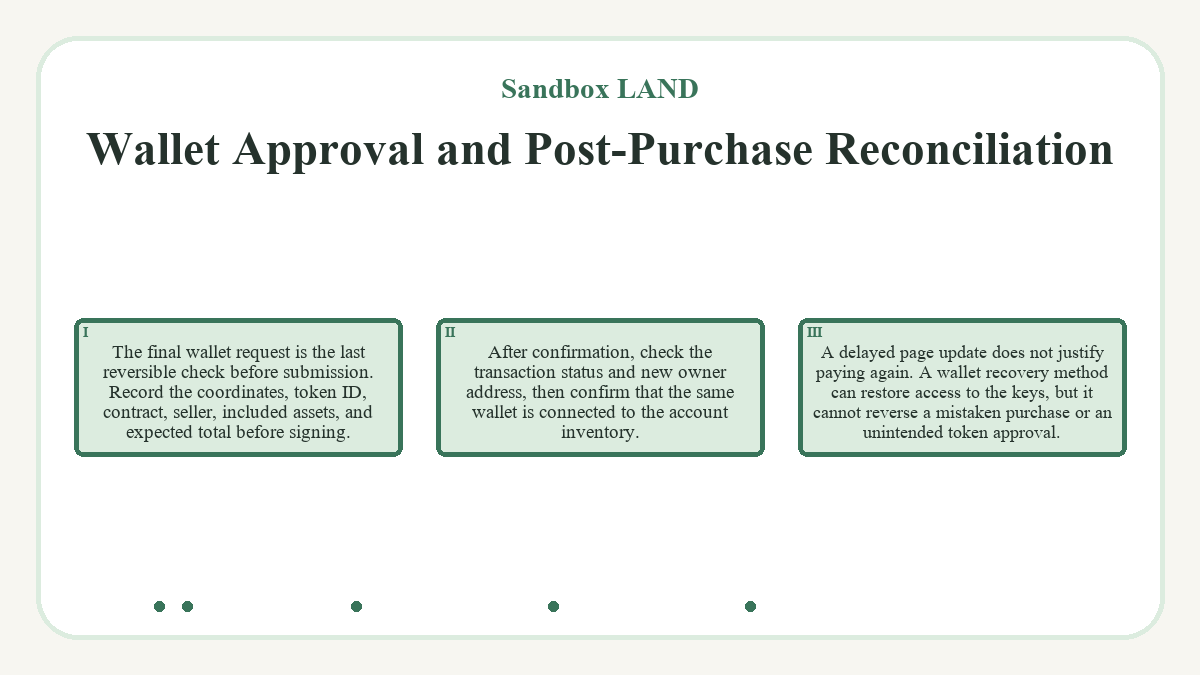
The final wallet request is the last reversible check before submission. Record the coordinates, token ID, contract, seller, included assets, and expected total before signing. After confirmation, check the transaction status and new owner address, then confirm that the same wallet is connected to the account inventory. A delayed page update does not justify paying again. A wallet recovery method can restore access to the keys, but it cannot reverse a mistaken purchase or an unintended token approval.
Popular questions about Sandbox LAND
-
Must I Own LAND to Build and Test an Experience?
- LAND is not required to create or test an Experience in Game Maker. A creator can save a project, run it in Play mode, share it through the Game Maker Gallery, and create a free Experience Page without purchasing a parcel. LAND becomes relevant when the creator wants to publish the Experience at a map location. The required parcel footprint must then match the Experience size and orientation supported by the publishing tools.
-
When Is Account Verification Required for a LAND Purchase?
- Account verification is required for public LAND sales hosted by The Sandbox. The account must also remain eligible under the sale rules. Verification can take up to 48 hours, and some accounts may later require reverification because of policy or jurisdictional changes. A secondary marketplace purchase follows that marketplace’s requirements instead, although the buyer still needs a compatible wallet and enough funds on the listing’s network.
-
Are SAND Balances Interchangeable Across Ethereum and Polygon?
- SAND balances are network-specific even though SAND exists on both Ethereum and Polygon. A wallet holding Ethereum SAND does not automatically have spendable Polygon SAND for a purchase on The Sandbox website. The tokens may need to be bridged before the transaction. Compare the destination network, bridge status, wallet balance, and expected gas method before a sale window begins, since moving funds introduces another transaction and a variable completion time.
-
Can LAND Move Between Ethereum and Polygon?
- LAND can move between Ethereum and Polygon through the supported bridge. Bridging is a separate blockchain transaction that changes the network holding the token without changing its map coordinates. The destination wallet must remain under the buyer’s control, and the token should appear under the supported contract for the destination chain. Bridge timing and fees can vary with network conditions, so the transfer should finish before the LAND is needed for another transaction.
-
Does a LAND Purchase Include the Seller’s Experience and Other Assets?
- A LAND purchase transfers the parcel token and does not automatically transfer the seller’s Experience, project files, intellectual-property rights, or separate NFTs. A Premium parcel’s original bonus assets are also excluded unless the resale terms include their individual tokens. Read the bundle contents before pricing the offer, then confirm that every included asset has its own identifier and transfer action. A map thumbnail or published Experience does not prove that its underlying content is part of the sale.
-
Will a Failed Transaction Transfer the LAND?
- A rejected wallet request creates no blockchain transaction, while a transaction that fails on-chain does not transfer the LAND. The failed attempt may still consume a network fee because validators processed it. Check the receipt status, token owner, SAND balance, and any remaining spending approval before trying again. Do not submit another payment while the first transaction is pending; wait for its final receipt status and recheck the token owner.